Showing posts with label Urban. Show all posts

Sunday, 26 April 2015

Urban Geometry: Perspectives and Planes


Last summer, I put together a series of Polaroid photos which focused on the geometry of Berlin's (post-)modern architecture. Throughout this winter, I undertook a similar project with the Fujifilm X30 camera, again capturing 20th and 21st century architecture in Berlin, the result of which I recently uploaded in a new set entitled Urban Geometry: Perspectives and Planes.


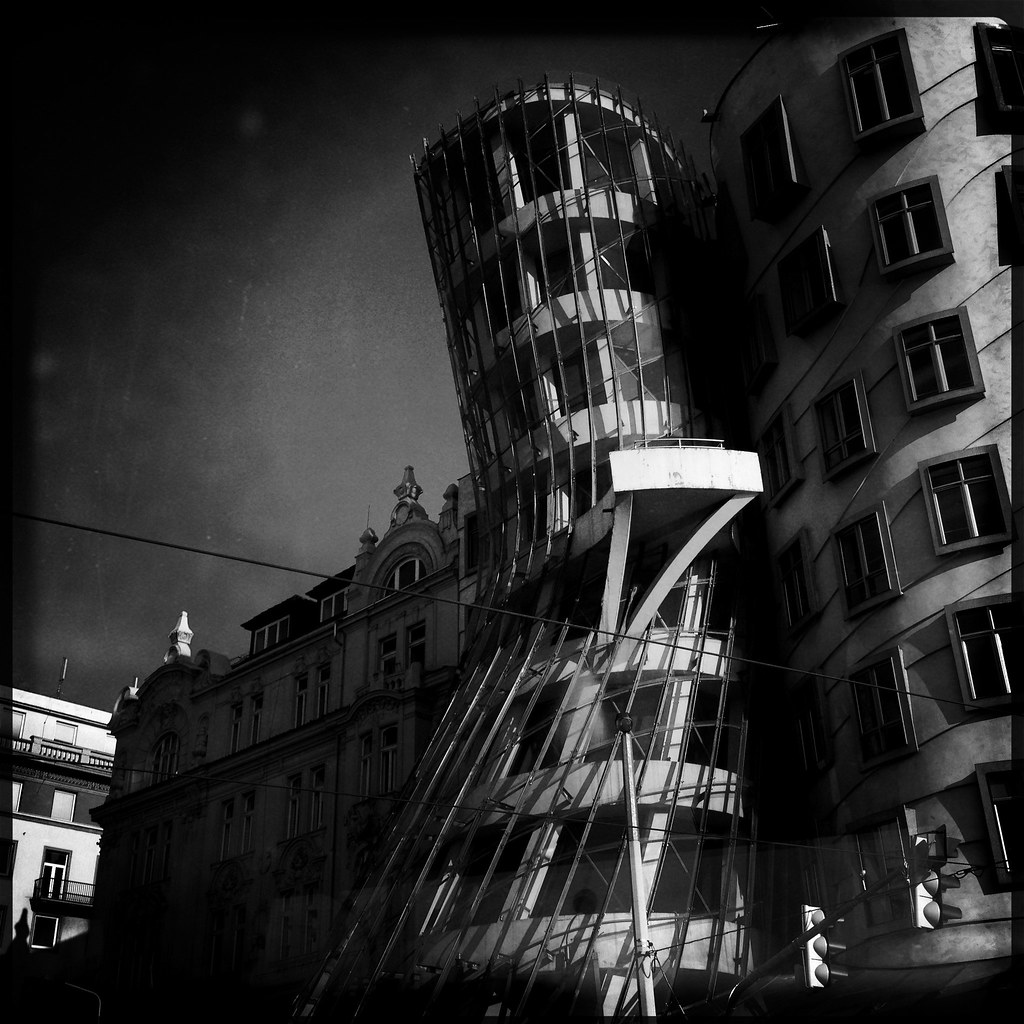
Although they have a common theme, the two sets are still very much different. These differences are defined by the medium (analog instant vs. digital), by the format (square vs. mostly 16:9 ratio) and most importantly, by the respective camera's lens and the approach that it allows. Using the Polaroid SX-70, I worked with the camera's fixed lense to focus on excerpts of buildings. The X30's zoom range, however, allowed me to capture buildings in their entirety, or even sets of buildings as depicted in the photo above. It also allowed me to zoom in on particular details if required. This, coupled with the chosen 16:9 ratio,  led the focus away from  the representation of the geometrical shapes of things. Instead, what came to the foreground were the lines, be they frames, pillars, beams or decorative patterns, horizontal or perpendicular or anything in between. 


Now I've said this elsewhere, but Berlin's architecture is basically an angular,
rectangular one, and you are hard pressed to find other shapes and forms - but they do exist. There are some great Bauhaus buildings around which make much use of curves (such as the Shell House), and even in the past years, some architects have managed to slip unusual designs by the stern gaze of  Berlin's conservative building authorities who so love their rectangular designs and orderly structures. The federal government buildings near the central train station consist of a weird amalgam of geometrical shapes of all sorts. And close by, in the model "Hansaviertel" neighbourhood, whose buildings date back to the 1950s, renowned architects such as Oscar Niemeyer forfitted traditional shapes and arrangements for more daring ones. In other words, the buildings I photographed for this project oftentimes go beyond the rectangular and angular.  


The buildings I concentrated on mostly date from the last 70 years. This includes public and office buildings as well as private housings and a couple of industrial buildings (one of which dates back to the late 19th century). The pictures feature buildings by architects such as Mies van der Rohe, Renzo Piano, Oscar Niemeyer, Walter Gropius, Hans Kollhoff and Hans Scharoun.


All photos are in black and white, and as mentioned above, have been taken with the Fujifilm X30 camera.

Links:

Saturday, 10 January 2015

Wide-Angle Urban Poetry, Vol. 2: London & Brighton


For the second year running I spent New Year's in Brighton, and same as last year I followed that vacation up with a stay in London. And same as last year, I brought back a number of photographs.

Last year I had taken the analog Lomo Belair panoramic camera with me. This year I decided to go digital and took the Fujifilm X30. I took it primarily because I was expecting bad weather and low light, which normally hampers the use of lo-fi analog cameras. However, luckily bad weather wasn't the norm, so that I ended up with a number of splendid colour photographs as well as black and white ones.

I'm particularly happy with many of the photos which I brought back from
London, especially the ones which I shot in and around the Barbican. I visited the Barbican Centre to see an exhibition, Constructing Worlds: Photography and Architecture in the Modern Age; a show which I thought quite brilliant, both for the theme and for the large number of exceptional photos on display. At the same time, the Barbican complex is in itself a highly photogenic urban jungle, bordering on the ever growing architectural frenzy (some would say mess) that is London's East End. Certainly it was no coincidence that the Barbican was putting on a show with this kind of theme, and so it was not necessarily a coincidence either that I ended up with a number of shots reflecting the theme of the show. 

The photographs which I took this year with the Fujifilm X30 in many ways compliment the panoramic pictures which I took last year with the Belair camera, so I combined the two in a common set, adding also a number of Polaroids which fit the theme of urban panoramas, as well as a couple of 'Holgaramas' from 2008, and a collage which I did in 2004 of Saint Paul's as seen from the Tate Modern. Altogether they also illustrate how fast London's skyline keeps changing, for better and for worse. Additionally, the photos illustrate another facet of London which I always found fascinating: here, the various epochs of London's long history do not so much co-exist side by side, but seem to pile up on top of each other. The picture above is a good example as it shows tiers of buildings from various centuries, combining the medieval church of St Giles-without-Cripplegate with buildings from the 19th, 20th and 21st century high rises into a very crowded skyline.


Links:


Thursday, 25 December 2014

Signs of the Times


Last year I published a set of instant photos entitled Fragments: Signs of the Times, which I just updated with a selection of photos taken throughout 2014. Fragments is a collection of images depicting public art, graffiti, posters and other symbols (both permanent and temporary) which epitomise Berlin at a certain instant in time. The permanent structures tend to reflect much of Berlin's late 20th century history, especially its division, as they symbolise, and sometimes directly address, the tastes, affiliations and beliefs typical of West and East Berlin respectively - not just pre- but also post-fall-of-the-wall. The more temporary displays - graffiti, posters etc. - on the other hand reflect moods, tastes and opinions of the moment in time when the pictures were taken - current then, but history a couple of weeks, months, years down the line.

All the photos except one were taken with Polaroid cameras and a variety of Impossible Project films, both colour and black and white. 

Sunday, 14 December 2014

Berlin Digital


It's been a while since I posted any exclusively digital sets, obviously because I have more than ever been concentrating on analog photography for the past two years. I still enjoy shooting on the iPhone, though, and recently I put together two collections of images which I shot around Berlin on the iPhone. 

The first one is called Angular Designs and is basically a collection of architectural photographs focusing on the indeed very angular approach to designing buildings in Berlin. Whether it's down to regulations, cost restrictions or architects' lack of imagination, many if not most of the buildimgs built from the middle of the 20th century until today rely heavily on a purely angular form.  Curves are a stylistic element found few and far between, and although notable exceptions exist - Sony Center, Haus der Kulturen etc. - there doesn't seem to be as much architectural diversity found in Berlin as in other cities - nor as much extravagance. Which doesn't mean that it has to be all boring. It isn't... but you get the feeling that with all the building going on, there should be so many more buildings with a distinctive 'wow' effect factor. Put that down to Prussian bureaucracy and desire for order, going so far as to actually stipulate the ratio of glass to stone that can exist in a building's façade...

I guess if I want to put together a collection of curves and round shapes in architecture, I will need to look abroad mostly.....

The second set I added is simply a collection of black and white photos from the last four years or so. Some of the photos are presented as they were taken, but on a number of them, I also applied a fair amount of post-processing using various apps on the iPhone. The set also includes a short series of night shots which I entitled Night Hawks, a theme I may want to explore further in the near future.

Links:

Tuesday, 9 December 2014

Urban Geometry

Urban Geometry is the title of a new set which I've recently added to the Polaroid section of the site. In it, I explore the geometry found in modern architecture and urban development. I shot these images chiefly in Berlin over the course of 2014.

Saturday, 6 September 2014

Berlin in Black & White


These past months I've been heavily shooting black and white instant films. One of my favourite films has turned out to be Impossible Project's new 'Hard Color' film with its solid colour frames and stark contrasts, a combination I really like; but I've also been using that other favourite film of my, the black framed one.

I've put together the best of the urban-themed photos which I shot around Berlin in a new set entitled 'City Polaroids: Berlin in Black & White' [Click here to view]. I've always loved black and white photography for its seemingly time-bending quality, that is, the fact that it couples memories of old classic photos with contemporary realities such as (post-)modern architecture and contemporary urban scenes. Or alternatively, how it evokes a sense of a lost past when photographing historic places or old buildings, a theme I explored in an earlier set, Another Time [read the blog entry here].

Enjoy...

Friday, 2 May 2014

Wide Angle Bucharest and London


I recently uploaded a series of photos from London and Bucharest (Romania), all of them taken with the Lomography Belair x 6-12 camera and using a 58mm lens. Contrary to the Berlin set posted earlier, I used the camera primarily to shoot buildings and vistas rather than the more intimate street scenes I captured in Berlin (see my earlier blog post here).


Here is the link: Wide Urban Angles


More of my Belair photos can be found [here].

Saturday, 29 March 2014

Wide-Angle Urban Poetry

I recently uploaded the second batch of photographs taken with the new Lomography Belair x 6-12 camera. Unlike with the first batch, the Brighton pics, I had with these rolls figured out how to hold the camera to properly format the images, which, guess what, vastly improves the results.

All of the photos were taken in Berlin between January and April, 2014. My first approach to shooting with the camera was to take advantage of the camera's ability to shoot panoramic 6x12mm and 6x8mm exposures, and the 58mm lens' wide-angle capacity, to take wide panoramic cityscape pictures. Later, I changed tactics: rather than take more panorama shots, I went for close-ups, thus being able to take in complete scenes and/or objects from close proximity, which allows both for a certain intimacy while providing the 'big picture' at the same time. Coupled with both the camera's and the lens' inherent distortions, the results are to, for lack of a better word, poetic...

Overall I'm vey pleased with the Belair, despite some technical, or rather mechanical, issues. Of these I plan to write later as I'm yet to write up a review of the camera. 

Here then is the link: Wide-Angle Urban Poetry
See also Brighton Winter for more Belair shots. 

Saturday, 28 December 2013

Lines and Light

As you might have guessed from previous postings, I like to photograph buildings. Often, I find a building at it's most fascinating when, on sunny days, it becomes clear how the architecture plays with light, be it in the way it reflects light,  breaks it, or lets it through. When lines and shapes are enhanced by light and by shadows. 

I just put up a new Polaroid set which reflects this, Lines and Light. The photographs were taken in Berlin, in Metz, France (some in the Centre Pompidou), and a couple in London.

Enjoy. 

Sunday, 9 June 2013

Polaroids from London and Brighton

I uploaded a selection of the polaroids I shot while visiting London and Brighton a couple of weeks ago. I alternated between colour and black & white films, using predominantly the black-frame 600 UV+ film, which has become my favourite black & white film. The weather alternated between sunny and stormy and rainy, so that I ended up with pics of blue skies as well as stormy seas.... 
– Brighton Polaroids
– London Polaroids


Monday, 1 October 2012

Street Art by Instax

While on the lookout for motives for the 'Occupying Spaces' project (see blog entry a bit further down), I started shooting graffiti and interesting street art using the Fuji Instax 210 camera. While the Occupying Spaces project is now at an end, I still enjoy photographing interesting pieces of street art when I happen to see some. I've put up a selection of the shots I liked best. With there being so much street art here in Berlin, I figure this set is pretty much going to be a work in progress...

Here is the link: [Urban Art].

Thursday, 27 September 2012

City Polaroids

When back in June I started taking photos with the newly acquired Polaroid camera, and after playing around with it to explore the camera’s and the films’ strengths and weaknesses, I decided on several projects that attempt to portray the city (Berlin) not by photographing its landmarks or its buildings, but by focusing on details. Following that approach, I went about shooting its cemeteries (which I wrote about earlier) and Berlin’s 'occupied spaces’ (read more here).

Additionally, I ended up taking a series of random photos around town, most of them, again, focusing on details, even if I ended up taking one or the other landmark and buildings shot. When I visited Budapest in June, I decided to also apply the same principle to the photos I took there. Now, it is debatable to what degree these photos really ‘portray’ a city or just present a highly subjective kaleidoscope that may or may not add up to a full image. Be that as it may, in the end, the most important thing was getting a series of good photos, and I hope to have achieved that.

So here then, as the second-to-last ‘project’ for this summer, is a selection entitled City Polaroids. All photos were taken on Polaroid SX-70 cameras using Impossible Project films, both colour and black & white. Enjoy.

Here are the links:

Monday, 24 September 2012

Occupying Spaces


Now that summer is wrapping up, I’m also wrapping up my summer projects. I have just added a new set of Polaroids to my site, entitled “Occupying Spaces”, a photo documentation of sorts of occupied places in Berlin.

Occupying public, or indeed private, spaces has had a long history in Berlin. During the time of the Berlin Wall, at a time when living space was limited in West Berlin, many real estate developers let apartment building stand empty in order to get permission to tear the rotting buildings down and build new ones. Many, if not most, of these buildings ended up being occupied by squatters. Similarly, another phenomenon occurred on unused (or disused) public terrain: squatters used them to set up camp, living in trucks, sheds and mobile homes. As they fortified the camps against possible raids by the city authorities, these settlements became known under the Wild West term of “corral” (“Wagenburg” in German).

When the Wall came down, squatting bloomed briefly in East Berlin as well as people found more disused buildings to occupy, but in the 1990s, with Berlin being again the German capital, most of these buildings were cleared, often in violent confrontations between the occupiers and the police (or the government came to an arrangement with the occupiers who’d eventually became owners of the buildings); and most of the “corrals” were cleared as well, 

However, that whole “cleaning up the city” act by the city government does not mean that there are no more occupied spaces today. There are still a few corrals left here and there; and a couple of squatted apartment blocks also remain. Additionally, a number of old factories and warehouses along the Spree river which are left to rot as developers are seeking permission to tear these old buildings down and erect shiny new office palaces on the much-priced water front, have now been occupied by squatters who live there, artists who work there, or modern day nomads from all over Europe who come to stay there for a while. And, it has to be said, by trigger happy tourists who have read about these places in the latest tourist guides….
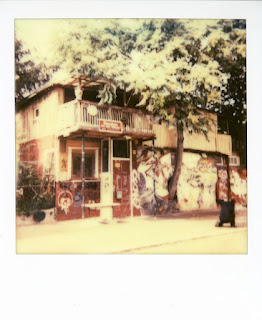
Then there is the curious case of Osman Kalin’s tree house. Mr. Kalin, a Turkish immigrant, set up a garden and tree house on a patch of land that technically belonged to East Germany but was located on the Western side of the Wall. During the separation of the halves of the city, he was left alone by both authorities, but after the Wall came down, pressure was put upon him to tear down the tree house. Mr. Kalin persisted… and lives there still. 

Unused areas along the river also became the site for a good number of improvised beach bars - now unfortunately getting replaced by commercial venues as Berliners' fondness for sipping beer and cocktails by the river has been established. 

Yet another now popular past time is for local residents to set up improvised gardens, playgrounds and even pet zoos in patches of unused and/or unclaimed land.

In other words, Berliners are still busy (re-)claiming their city from what they perceive as willful negligence by those trying to make a quick buck out of… doing nothing.

As one of my summer projects, I tried to document these “occupied spaces” with the Polaroid cameras. I visited occupied factories and derelict buildings, a couple of the remaining “corrals”, improvised “beaches” and camp sites.

There are a couple of remarks I should add. One is that, as you can see, graffiti plays a big role in occupying these spaces – as indeed it represents a ‘marking of the territory’. As such, I extended the scope of the photo selection to also include random, interesting graffiti around the city not necessarily linked to occupied places.

As to the “corrals”: the inhabitants of these camps are notoriously private and averse to visitors, especially those carrying cameras. For a good reason: since some of the tourist guide books have started “featuring” them, the corrals have become tourist attractions of their own. Thus, while I photographed the surrounding “public” areas (taken up by mostly by graffiti and art work), I did not manage to get any photos taken inside the camps proper, which I find too bad.

I used primarily a couple of Polaroid SX-70 cameras with a variety of Impossible Project films, including the new “color protection” film.

In a few instances I also used the Fuji Instax 210 camera, and I added an additional gallery with only the instax photos on urban art.

Links:


Tuesday, 12 June 2012

New instax photos

I have posted more photos taken recently with the Fuji Instax camera to the [instax page]. This batch was taken around the Kreuzberg area of Berlin. I'm still enjoying capturing the instant photos with this ugly little thing.
Check out both the City and the Summer sections of the instax page.

Friday, 25 May 2012

Prague in (Almost) Black & White

I spent a few days in Prague earlier this month. It's a city that is charming enough but is a bit over-run by tourists - well, no wonder, it does have sights to spare. Here is an album of photos I shot there. Most of them are in black and white, which suited both the city and the weather. Like so many recent sets shot on recent trips, about half the photos were taken with an iPhone and the other half with a Holga.

Friday, 13 April 2012

Kuala Lumpur


Added a new set with photographs from a recent trip to Kuala Lumpur, with an additional handful of pictures I shot on an earlier trip in 2005. The photos were all shot with a Holga camera and an iPhone.

Monday, 18 July 2011

Rome

Added a whole section of set with photographs taken in Rome last June. They include a couple of sets of street photography taken with Holga cameras, and another one taken with the iphone. One set deals specifically with the Roman ruins around the city, and another one with pictures shot inside the many museums of Rome [Click here to view].


[01Aug2010: Rome sets also available in the Holga gallery]

Friday, 21 January 2011

Urban Section Redesigned

The re-design and re-organisation of the Urban section is now finished. There are a few new sections as well: Building for Utopia showcases surrealism in architecture; Paris B&W contains black & white wide-angle photos taken with the Holga 120WPC, and the two Where Angels Tread sets feature images of cemeteries. Enjoy.

Tuesday, 7 December 2010

New Urban iPhone Photographs

I've added a whole section of iPhone photographs to the Urban gallery with a series of recent photos, mostly from Berlin.
Additionally, I added a few sets of photos taken in Paris. 

Monday, 28 December 2009

Around Berlin 2009

I've uploaded a series of pictures taken throughout Berlin in the course of 2009; ranging from the few cold snowy days in January to the first snow in December. The colour photographs were taken using the Holga 120N and 120WPC cameras, and the black and white ones with the Diana+ camera.

The gallery can be accessed from the toy camera page by following the "Berlin Around Town 2009" link.